debt snowball vs avalanche
There are two well-known ways to pay off several debts. Both work. They differ only in which debt gets your extra money first, and the right one is the one you will stick with.
What both methods share
You pay the minimum on every debt, every month. Then you put every spare amount on one target debt. When that debt is gone, its whole payment rolls onto the next target. The payments get bigger as you go, which is why the last debts fall quickly.
The snowball: smallest balance first
List your debts from the smallest balance to the largest and attack the smallest. You clear a whole debt quickly, which feels good and frees up a payment early.
- Good for: people who need quick wins to stay motivated, or who have several small debts.
- The cost: you may pay more interest overall, because a large high-interest debt waits its turn.
The avalanche: highest interest first
List your debts from the highest interest rate to the lowest and attack the highest. Every extra payment goes where it saves the most.
- Good for: people who are motivated by the numbers, or who have one expensive debt such as a credit card or store account.
- The cost: if the highest-rate debt is also large, the first win can take a long time.
A worked example
Say you have three debts and 150 a month spare beyond the minimums:
- Store card: 400 owed at 22% interest
- Credit card: 3,000 owed at 26% interest
- Car loan: 6,000 owed at 9% interest
With the snowball you clear the store card in about three months, then roll that payment onto the credit card. With the avalanche you start on the credit card, which saves a little more interest, but your first cleared debt is more than a year away. Here the two orders are nearly the same after the first step, so the snowball's early win costs very little. That is common: when your smallest debt also has a high rate, the methods agree.
How to choose
- If you have tried before and given up, choose the snowball.
- If one debt has a much higher rate than the rest and you are patient, choose the avalanche.
- If you cannot decide, clear one tiny debt first for the win, then switch to highest interest.
What matters more than the method
Finding the extra money and not adding new debt. A written list of every debt, a fixed payment day and a way to see progress do more than the order you pay in.
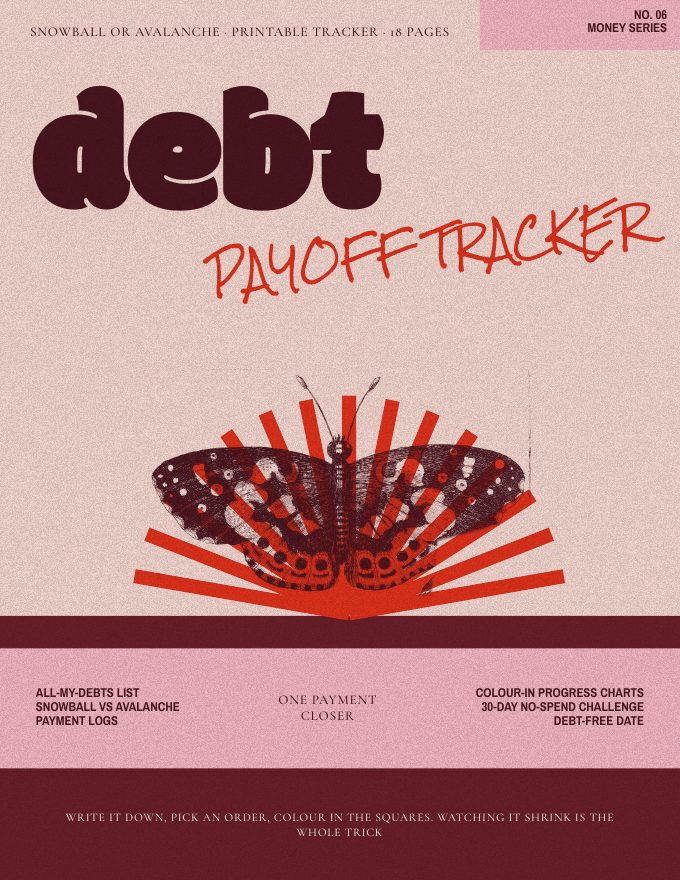
debt payoff tracker
18 printable pages: list every debt, set your payoff order, track each payment and colour in your progress, with a payment calendar and a 30-day no-spend page.
See the printable · $7This guide is general information, not personal financial advice.